

The Daughters of the American Revolution (DAR) and the Sons of the American Revolution (SAR) opened the Scribner House doors and hosted a temporary encampment on Saturday, Oct. 11, 2025 from 11 a.m. to 2 p.m. at 110 E. Main St., New Albany, Ind. The event was an educational outreach promoting historic preservation, patriotism, and awareness of early American life. The public was able to experience the lifestyle and conditions of the period through many activities: historical clothing presentations, flag explanations, militia and frontier camp life displays, lessons on medicine and schooling, as well as period music and food. Mary Warren, event participant, reflect s on her experience at the event, “I would love to step back in time. Today’s time… People don’t know what we went through and what we had. We had each other.”
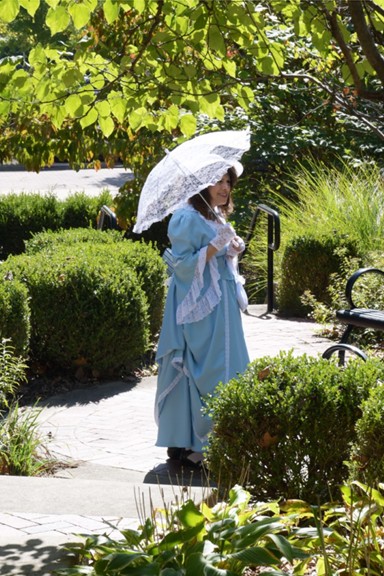
during the 18th century by explaining its relation to her 18th century period clothing as she walks
down to the fountain located behind the Scribner House.
(Mackenzie Kaskie)
Volunteers and reenactors from Indiana and Kentucky traveled to this event to assist local historical societies in organizing and presenting demonstrations. Kimber Krajnak, DAR member of four years, explained what it meant to honor women from the 18th century, “I am giving… the ladies and matrons and ancestors before me a voice that back during their time they didn’t have… I feel like they’re kinda with me to say, ‘hey– tell our story… Let us be heard’.” The Scribner House, one of the oldest structures in New Albany, was once home to the city’s founders. The annual Harvest Homecoming Festival was created to facilitate community connection and to showcase local history making it an ideal opportunity to showcase New Albany’s heritage. This experience helped residents and visitors feel more connected to their city’s roots.
For many reenactors and volunteers, the Scribner House event was more than just showcasing history. Kimber Krajnak, DAR Member, shares the deep sense of purpose she feels in being a reenactor, “I want my children to know that [the United States’ development] is through blood, sacrifice, time, [and] energy… It’s a gift– it’s not something to be just tossed away… If you don’t know where you came from– where are you gonna go?” Krajnak’s dedication reflects the belief that history is not meant to only be observed but presented in a way with meaning and respect. The members of the DAR and SAR continue to keep the stories of early Americans alive for future generations to come. Penny Meier, DAR member, speaks about what she hopes visitors gain from the event, “…It’s interesting to spark that interest for [someone] to actually dive deeper into history and let them become a reenactor.”


